
Product-Manager-Skills
49 practical product management skills plus 6 command-driven workflows.

Suggested prompts
About this skill
Product Manager Skills
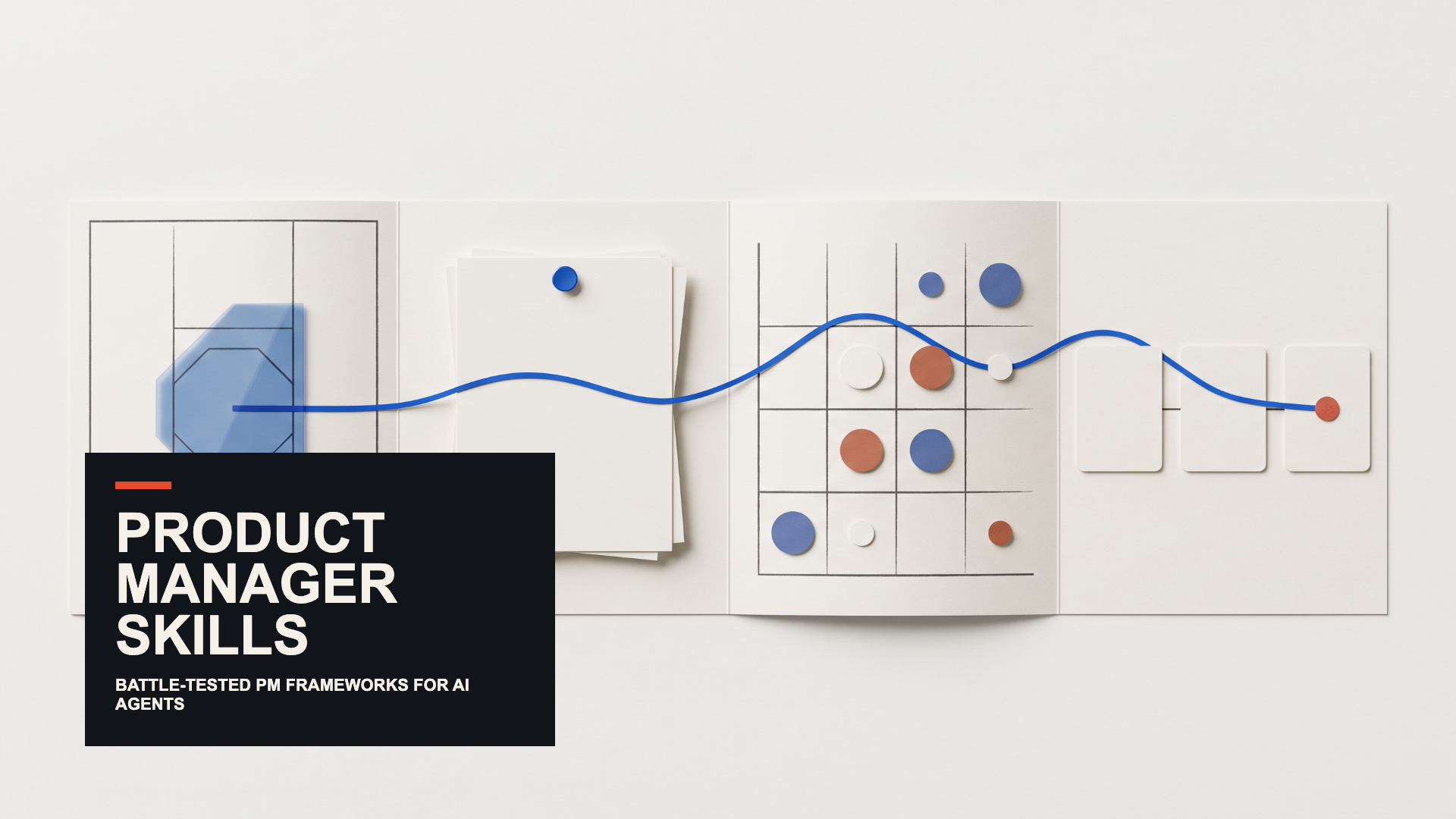
70 battle-tested product management frameworks that work with Claude, Codex, ChatGPT, and any AI agent capable of reading structured knowledge. Give your agent shared context and professional judgment so it produces actionable work.
Why Use This
When you tell an AI agent "write a PRD" without shared context, you get generic output. This library provides professional frameworks that both you and your agent can rely on. Each skill includes the reasoning behind it, common pitfalls to avoid, and guidance for applying it correctly.
Skills Overview
Navigate by what you're trying to accomplish.
Framing and strategy
- problem-framing-canvas — MITRE's Look Inward / Look Outward / Reframe sequence; stops teams from solving the wrong problem
- positioning-statement — Geoffrey Moore's template for defining who you serve, what you solve, and how you're different
- product-strategy-session — full strategy arc: positioning → problem framing → solution exploration → roadmap (2-4 weeks)
Stakeholder alignment
- stakeholder-identification — map every stakeholder before engaging anyone: broad brainstorm → allies/audiences/influencers → R/P/D marking → equity lens → narrow to priority targets
- stakeholder-mapping — run two complementary grids (Power × Interest for engagement strategy; Impact × Power for whose voice to elevate) and compare to find the gaps
- stakeholder-engagement-advisor — per-stakeholder engagement planning: diagnoses their profile and context, then delivers tailored message framing, medium, cadence, and a named next action
Customer discovery and research
- discovery-interview-prep — plans Mom Test-style interviews based on your research goals
- opportunity-solution-tree — generates opportunities and solutions, then recommends the best proof-of-concept to test first
- discovery-process — complete discovery cycle: frame → research → synthesize → validate (3-4 weeks)
Prioritization and roadmapping
- prioritization-advisor — asks 3-5 questions about your context, then recommends RICE, ICE, Kano, or the right alternative
- epic-breakdown-advisor — splits large epics using Richard Lawrence's 9 patterns
- roadmap-planning — gather inputs → define epics → prioritize → sequence → communicate (1-2 weeks)
Writing PM deliverables
- user-story — Mike Cohn format + Gherkin acceptance criteria, with anti-patterns
- prd-development — structured PRD: problem → personas → solution → metrics → stories (2-4 days)
- press-release — Amazon Working Backwards: clarify product vision before writing a line of spec
Validation and experimentation
- pol-probe-advisor — recommends which prototype type to run based on your hypothesis and risk level
- pol-probe — template for documenting lightweight validation experiments before building
Finance and growth
- business-health-diagnostic — diagnoses SaaS health across growth, retention, efficiency, and capital using your real metrics
- organic-growth-advisor — McKinsey Growth Pyramid triage: diagnoses whether your constraint is in new segments, geographies, channels, or products
- feature-investment-advisor — build / don't build recommendation using revenue impact, cost, ROI, and strategic value
Market and competitive intelligence
- intel-discipline-advisor — start here: triages the question on your desk into the right intelligence disciplines, cadence, and executing skill
- competitive-analysis-process — the six-step umbrella: landscape → product comparison → customer needs → business baseline → positioning → strategic direction
- The investigation chain: market-landscape-scan → competitive-research-snapshot → competitive-intel-watch → battle-card-builder — each consumes the prior's schema, so research becomes a cadence instead of a one-off deck
- tam-sam-som-calculator — market sizing three ways: your own numbers, guided interview, or autonomous bottom-up research a skeptical CFO can attack one assumption at a time
Career and leadership transitions
- director-readiness-advisor — coaches PMs through the PM→Director shift across four situations: preparing, interviewing, newly landed, recalibrating
- vp-cpo-readiness-advisor — coaches Directors through VP/CPO transition, including a CEO interview framework for evaluating roles before you accept
- executive-onboarding-playbook — 30-60-90 day diagnostic playbook for VP/CPO transitions
AI product work
- ai-shaped-readiness-advisor — assesses whether you're automating tasks (AI-first) or redesigning how you work (AI-shaped), then tells you which competency to build first
- context-engineering-advisor — diagnoses context stuffing vs. context engineering and guides memory architecture for AI-powered products
- agent-orchestration-advisor — guides multi-agent workflow design across four dimensions
Skill Types
Skills are organized in three tiers that build on each other:
- Workflow Skills (19): Complete end-to-end PM processes (days to weeks). Example: run a full discovery cycle or write a PRD.
- Interactive Skills (27): Guided discovery — 3-5 questions, then recommendations. Example: "Which prioritization framework fits here?"
- Component Skills (24): Templates for specific PM deliverables (30-90 min). Example: write a user story with acceptance criteria.
Interactive skills use an Adaptive Decision Ladder: they ask 3-5 targeted questions about your context, offer numbered recommendations with "use this when" rationale, and explain the why as they go. You can also just ask to learn the framework without doing the work.
How Each Skill Works
Every SKILL.md file follows this structure:
| Section | What it contains |
|---|---|
| Frontmatter | name, description, type, intent, best_for, scenarios |
| Purpose | What this skill does and when to reach for it |
| Input | What you can bring (with example invocations) — arriving empty-handed is fine; the skill walks you through it |
| Key Concepts | Frameworks, definitions, anti-patterns — with vocabulary explained |
| Application | Step-by-step instructions an agent (or human) can follow |
| Examples | Real-world cases showing both good and bad versions |
| Common Pitfalls | Named failure modes with consequences and corrections |
| References | Related skills and external frameworks |
The best_for field lists 3-5 specific scenarios where the skill is most useful, so you can quickly scan whether it fits your situation.
Documentation
| Document | Purpose |
|---|---|
| Using PM Skills 101 | Beginner-friendly orientation — setup without technical overload |
| Platform Guides for PMs | Tool-by-tool setup chooser for every supported platform |
| Using PM Skills with Claude | Claude Code + GitHub ZIP upload for Claude Desktop/Web |
| Using PM Skills with Codex | Local workspace + GitHub-connected Codex on ChatGPT |
| Using PM Skills with ChatGPT | GitHub app, Custom GPT Knowledge, and Project-based usage |
| Using PM Skills with Slash Commands | Turn skills into reusable slash commands like /pm-story |
| Market Intelligence Suite Summary | The 14-skill competitive/market research suite: disciplines, chain, and which skill to run when |
| START_HERE.md | 60-second onboarding for local repo users |
License
CC BY-NC-SA 4.0 — non-commercial use with share-alike.
- ✅ Use these skills in your day job — at a for-profit company, with your team, in your agents.
- ✅ Adapt and remix them — share what you build under this same license, with credit.
- ✅ Teach with them — workshops, brown bags, mentoring.
- ❌ Don't sell them — no repackaging the skills themselves into a paid product, course, or service without express written permission.
- 🤔 Not sure your use qualifies? Open an issue on the repository to ask.