
enterprise-company-research-agent
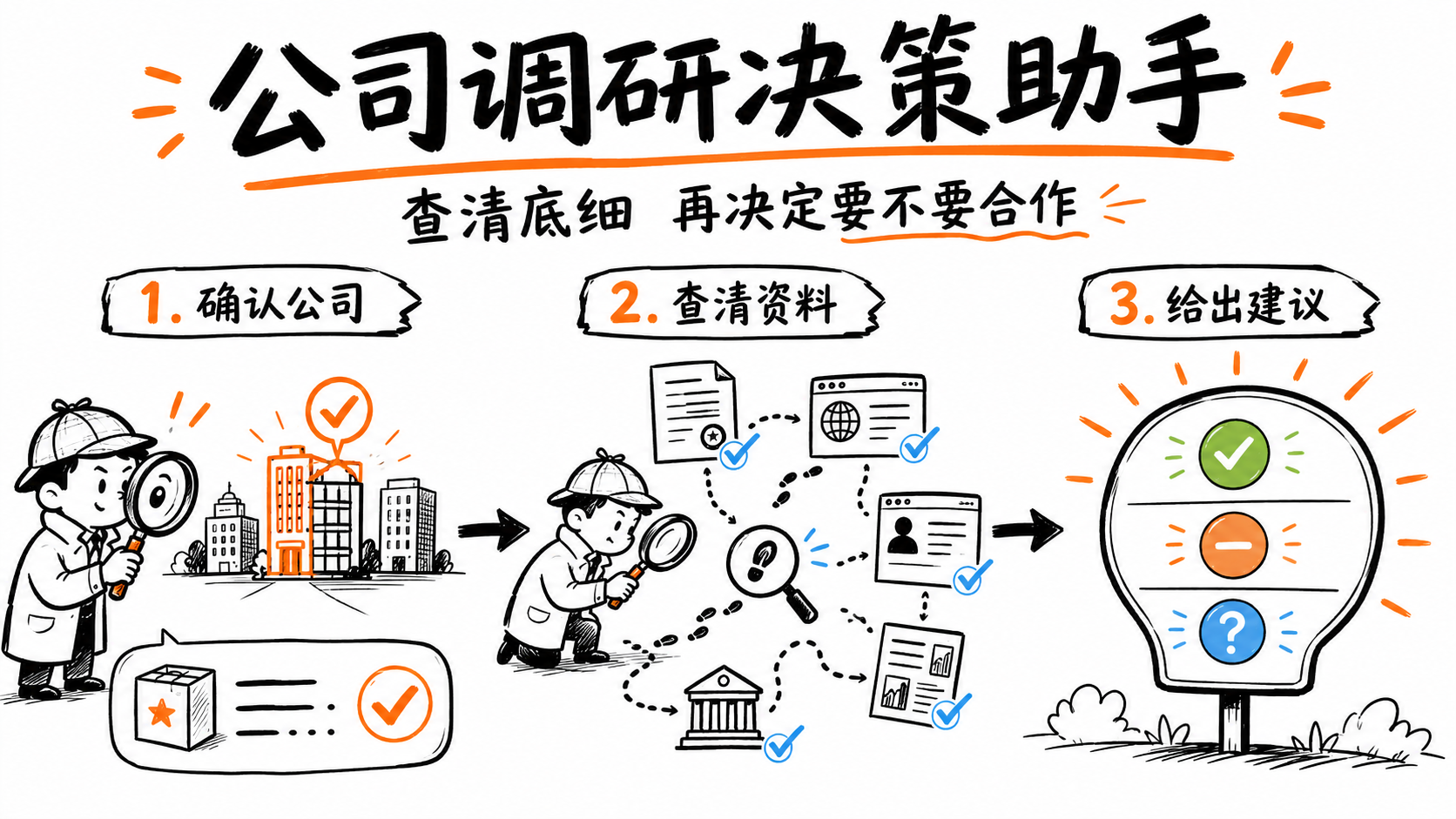
Decide whether a company is safe to buy from, partner with, or depend on: verify who it is, how it is doing, and produce source-backed judgments.
Suggested prompts
About this skill
An Agent Skill for enterprise supplier, company, and product research: verify who the subject is and what its current state is, then produce evidence-backed reports for procurement, partnership, competitive analysis, customer research, and investment screening.
Enterprise Company Research Agent is a lightweight but structured enterprise research skill. The user only needs to say who they want to research and what decision they need to make. The Skill helps an agent turn public evidence into:
- identity and scope verification
- lifecycle timeline from founding or launch to today
- product capability and commercialization status
- competitor, substitute vendor, and dependency comparison
- risk, compliance, data security, and delivery-capacity judgment
- traceable evidence ledger
- procurement or partnership recommendation
Its job is not to write a company profile. Its job is to make “can we buy from it, partner with it, depend on it, or diligence it further?” inspectable.
When To Use
Use this Skill when you want to:
- evaluate whether a new supplier should enter a procurement shortlist
- check whether a product is commercially real and has credible customers
- compare competitors, substitute vendors, or potential partners
- clarify relationships between a company, subsidiary, brand, product line, and parent company
- prepare material for procurement, legal, risk, security, sales, strategy, or investment teams
- get current, accurate, source-backed company and product research
It is usually not the best entry point for three-sentence definitions, pure marketing copy, or source-free brainstorming.
How It Handles A One-Line Request
The user does not need to fill out a full form or know the legal entity first. They can start with business language:
Research whether this company is safe to onboard as a supplier.
Research Foodpal's current state, product, and team background.
Compare company A, B, and C and decide which one should enter the shortlist.
The agent first completes the research boundary, then chooses the right depth for the enterprise decision context.
| Input clarity | How the agent handles it | Output focus |
|---|---|---|
| Only company or product name | Verifies website, legal entity, brand/product boundary, and similarly named entities | Identity, current state, unverified items |
| Website and decision context provided | Runs evidence retrieval, product review, customer proof, and risk analysis | Standard enterprise research report |
| Competitors or alternative vendors provided | Adds horizontal comparison, substitutability, and procurement recommendation | Shortlist / vendor comparison |
| Risk or compliance concerns provided | Prioritizes litigation, penalties, certifications, data security, sanctions, and export controls | Risk memo and follow-up diligence questions |
What The User Should Provide
Minimum input:
| Field | Example |
|---|---|
| Research subject | Company, supplier, product, brand, group, subsidiary, person, or category concept |
| Decision context | Procurement onboarding, renewal, competitive analysis, customer research, partnership review, investment screening, or risk alert |
Recommended additions:
| Field | Example |
|---|---|
| Known links | Official website, product page, hiring page, press release, registry or regulatory link |
| Geography | China, U.S., EU, Southeast Asia, global |
| Focus questions | Data security, delivery capacity, product maturity, pricing, litigation, penalties, financial stability |
| Comparison targets | Known competitors, backup vendors, internal alternatives |
| Output requirements | Quick memo, standard report, full diligence; Markdown, PDF, slides, spreadsheet, bilingual |
Incomplete input is fine. The agent labels reasonable assumptions and unverified items instead of turning guesses into facts.
What The User Gets
A standard report usually includes:
- Decision summary: one-line conclusion, recommended action, top risks, strongest evidence.
- Identity and scope verification: legal entity, brand, product, parent/subsidiary relationships, and exclusion of similarly named entities.
- Lifecycle narrative: founding/launch background, milestones, strategy shifts, financing, customers, and organizational changes.
- Current state: operating status, organization signals, funding/revenue/customer signals, hiring and expansion signals.
- Product and capability: core functions, technology, deployment, pricing/contract signals, maturity.
- Customer and market proof: customer cases, industries, buyers, renewal/replacement/user-feedback signals.
- Horizontal comparison: competitors, substitute vendors, upstream/downstream dependencies, capability/price/delivery/risk matrix.
- Risk and compliance: litigation, penalties, reputation issues, sanctions, export controls, certifications, privacy, and security posture.
- Scenario judgment: most likely, most dangerous, and most optimistic scenarios.
- Evidence ledger: visited sources, key facts, conflicting claims, unreachable sources, next diligence questions.
How It Differs From Search Or A Company Profile
| Method | Focus | Main output | Best for |
|---|---|---|---|
| Web search | Finding information | Links, snippets, fragmented facts | Quickly learning a name |
| Company profile generation | Writing a description | Company story and product description | Marketing, sales, or background material |
| Enterprise Company Research Agent | Enterprise decision-making | Evidence ledger, risk judgment, peer comparison, procurement/partnership recommendation | Supplier onboarding, competitive analysis, partnership review, investment screening |
The Skill is most useful when “there is a lot of information” needs to become “which facts are reliable, which conclusions are usable, and where we cannot judge yet.”
Common Scenarios
| Scenario | Why this Skill fits | Main artifacts |
|---|---|---|
| New supplier onboarding | Enterprises need legal entity, delivery capacity, customer proof, and risk checks | Supplier report, risk list, follow-up diligence questions |
| Competitor or substitute shortlist | The decision depends on maturity, customers, pricing, and replacement risk, not only features | Comparison table, procurement recommendation, substitutability judgment |
| Customer or partner research | Sales and BD teams need company state, product context, and organization signals | Customer profile, business signals, partnership entry points |
| Investment screening | Teams need to know whether the company is active and whether the product is mature | Screening memo, evidence grades, risk notes |
| Confusing brand/subsidiary structure | Similar names, product lines, and overseas entities are easy to mix up | Identity verification, scope notes, conflicting sources |
| Negative news or compliance alert | Single databases can mislead; multiple sources need reconciliation | Risk memo, conflict table, next checks |
Default Capabilities
- Current verification: For company status, funding, legal, product capability, customer cases, pricing, hiring, and certifications, browse and verify.
- Evidence priority: Prefer regulatory, registry, SEC, and exchange filings; then official pages, announcements, docs, executive statements, customer cases, hiring, patents, repos, reputable media, and third-party databases.
- Fact/judgment separation: Every key judgment must trace back to facts. Inference must be labeled.
- Scope control: Do not substitute parent-company data for product data or confuse similarly named entities.
- Procurement lens: The report must answer whether the subject is safe to buy from, partner with, or depend on.
- Conflict handling: When sources conflict, document the conflict in the evidence ledger instead of silently choosing one version.
Quality And Safety
- This Skill needs web access for “latest status” research. Without network access, current facts must be labeled unverified.
- Do not treat third-party databases as primary facts. Critical numbers and conclusions should be traced to original sources when possible.
- Do not commit customer data, internal review material, access tokens, private paths, or account information to a public repository.
- The README stays bilingual.
SKILL.mdandreferences/are the agent instruction layer and stay Chinese-only to control context cost; report output language follows the user, and bilingual reports are produced at the report layer.